But I Have Trusted in Your Steadfast Love
The mind is a fascinating thing. At any given moment, our brains are processing an almost incomprehensible number of signals, interpreting information from our bodies and our surroundings, anticipating what might happen next, remembering what has happened before, and trying to protect us. We often don’t even notice most of it. We touch something hot and instinctively pull away. We step awkwardly and our body responds before we have time to think. We experience pain and our brain tells us something is wrong.
Our nervous systems were designed to protect us. But what happens when the very system designed to protect you begins to misfire?
That is something I have become very familiar with. I live with autoimmune-related neuropathy. My neuropathy affects nerves responsible for sensations like pain, as well as nerves involved in regulating automatic functions like digestion and heart rate. For me, that can mean the signals coming from my body are confused, misfiring, or even absent.
Some days I feel almost normal and other days there is unbearable pain or functions like swallowing don’t go quite right. Sometimes I can manage it, and other times things like a simple hug, something that should communicate friendship and comfort, can feel like a searing knife.
The sensation is real. The pain is real. But the signal that is meant to protect me can be inaccurate. It is supposed to say, This is painful. Something is wrong. Get away from the source. But when the nerves misfire, the signal does not always accurately communicate what is happening.
The longer I have lived with this, the more I have recognized a parallel in my faith.
What happens when I begin interpreting my circumstances through the same kind of faulty signal?
The pain is real. Fear is real. Exhaustion is real. Grief is real. Chronic illness is real. But prolonged suffering can make what feels true seem more trustworthy than what we know to be true about God.
Circumstances can tell me that nothing is changing. Fear can tell me that I cannot keep going. Exhaustion can convince me that this will never end. Uncertainty can make me question whether God is really there.
And sometimes those voices can become much louder than the truths I know from Scripture.
There is a difference between acknowledging a feeling and allowing that feeling to become our theology. I can acknowledge that I am afraid without believing that God has abandoned me. I can acknowledge that I am exhausted without believing that God will not sustain me. I can acknowledge that I don’t understand without believing that God is not trustworthy.
This is one of the reasons I am so thankful for the Psalms. They don’t give us a picture of people who walked through suffering with perfect emotional composure. They show us people who were afraid, exhausted, confused, angry, lonely, and questioning God.
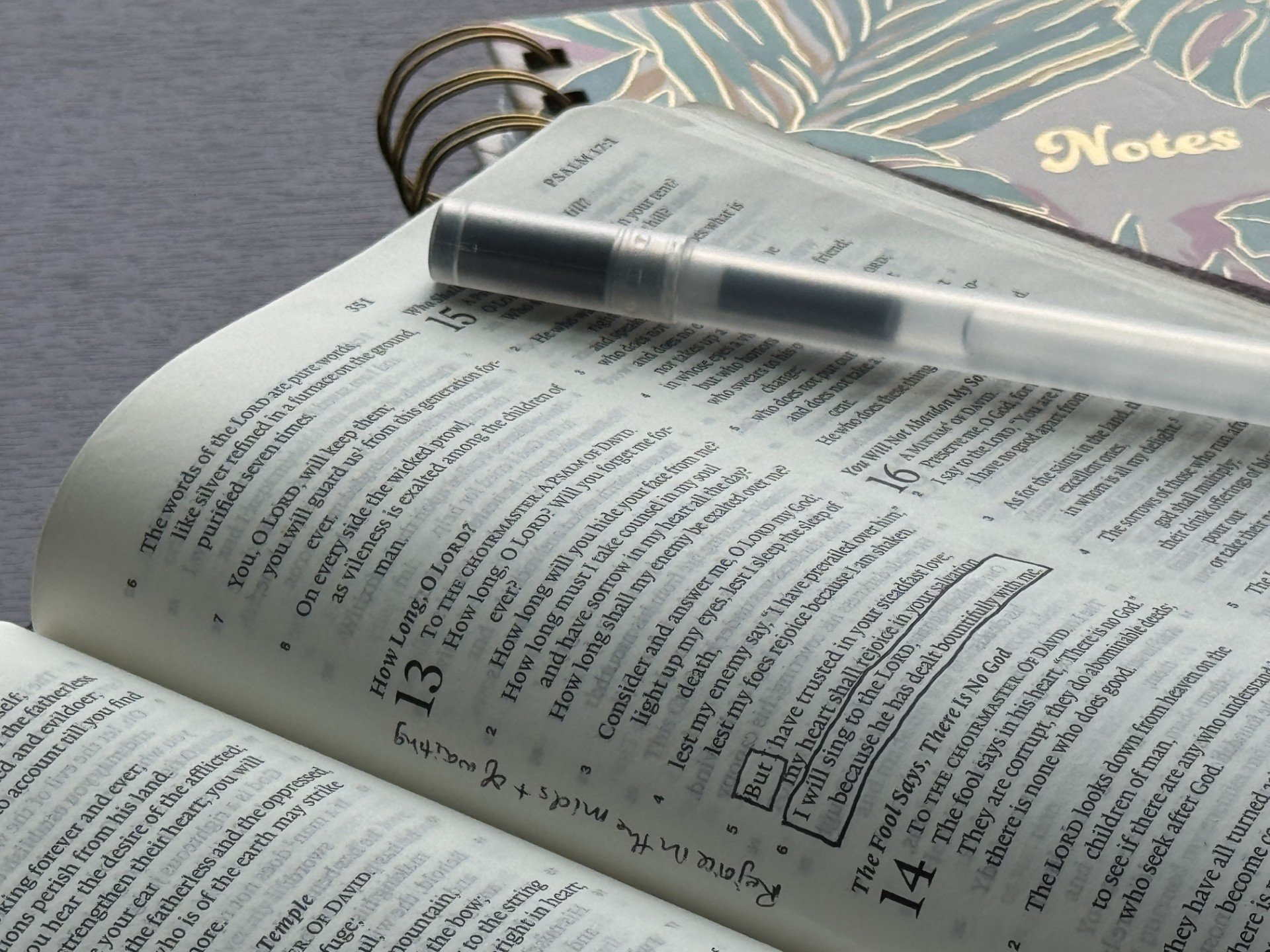
Psalm 13 is one of the passages I keep coming back to because it gives us such a beautiful picture of what faithful lament can look like. David’s prayer moves through four distinct places: lament, honesty, remembrance, and trust.
Lament
David begins, “How long, O LORD? Will you forget me forever?” He asks how long he will have to carry sorrow. He is not offering God a carefully edited version of his experience. He is crying out because he is hurting.
Lament says, This hurts. I don’t understand this. I am tired of waiting. I don’t know how much longer I can do this.
Lament is an expression of faith because David brings his pain to God rather than turning away from Him.
Honesty
David is honest with God. He doesn’t pretend that everything is fine. He doesn’t minimize his sorrow. Even though God knows what David is facing, this kind of honesty is about our posture before God. We bring what we are experiencing to Him and surrender it to His care.
But Psalm 13 doesn’t end there.
Remembrance
After pouring out his questions, David says, “But I have trusted in your steadfast love.”
His circumstances haven’t changed. His questions haven’t all been answered and his suffering hasn’t suddenly disappeared.
He remembers God’s steadfast love.
When my circumstances are loud, I need something more reliable than my circumstances to tell me what is true. I need to remember God’s character. He has been faithful before. He is faithful now. His love has not changed.
Trust
David says, “My heart shall rejoice in your salvation.” He trusts God even though he doesn’t have all the answers.
David doesn’t move from “Everything is terrible” to “Everything is wonderful.” He moves from lament to honesty, from honesty to remembrance, and from remembrance to trust.
His circumstances have not changed, but his response to them has.
Trusting God in the midst of hard things means that circumstances and feelings do not have the final authority over what is true.
My pain may be real, but God is still good. My fear may be real, but God is still faithful. My circumstances may be difficult, but God is still near. I may not understand what He is doing, but He is still trustworthy.
My nervous system can send a signal that feels completely real without accurately communicating what is happening in my body. In much the same way, I can interpret a circumstance through fear, exhaustion, or uncertainty and believe a story that isn’t the whole truth.
God is near to the brokenhearted. He is our refuge and strength. His grace is sufficient. His mercies are new every morning. He is faithful. He will never leave us or forsake us.
There are still days when what I feel is louder than what I know. There are days when pain, fear, exhaustion, or uncertainty can feel like the most trustworthy voice in the room. Sometimes the most honest prayer I can offer is the prayer of the father in Mark 9:24: "I believe; help my unbelief."
The strength to endure does not ultimately come from me; it comes from God. He is the One who meets me in the lament. He is the One who hears me when I am honest. He is the One who reminds me of what is true. And He is the One who gives me grace to trust Him when I don’t have the strength to do it on my own.
But I have trusted in your steadfast love; my heart shall rejoice in your salvation. Psalm 13:5