His Strength in My Weakness
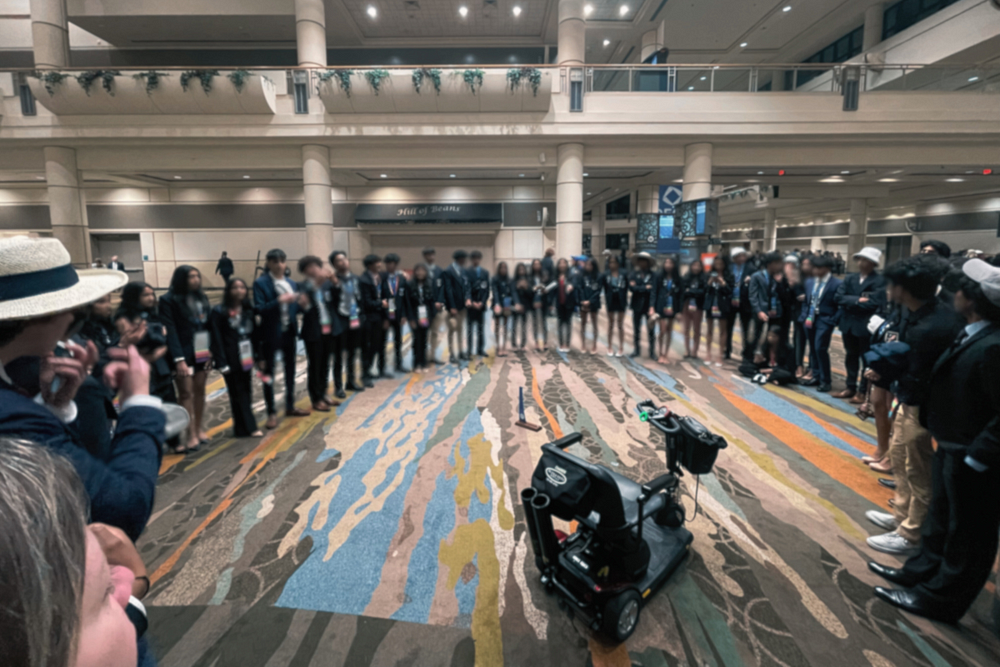
It was April 2023, and this was the scene at the DECA International Career Development Conference at the Orange County Convention Center in Orlando: a circle of 56 high school students, 8 adult chaperones, and a mobility scooter.
Four months earlier, I had been talking with a group of students about this upcoming trip and which Harry Potter ride we were most excited for. I voted for Escape from Gringotts, with Hagrid’s Motorbike as a close second. They had never ridden the Hogwarts Express, and I couldn’t wait for them to experience all the surprises.
More than that, I was looking forward to competition preparations, watching their confidence grow week by week and hearing the silly stories from late-night business plan sessions with their partners.
Sidenote: If you want to be encouraged by the next generation of leaders, volunteer to be a judge at a DECA district, state, or international competition. It is inspiring!
In late January, those preparations were interrupted by an episode of vertigo, accompanied by confusion and sensitivity to light and sound. As the months went on, the symptoms progressed. Now facing chronic vertigo, my emotions swung from excitement to panic. The fear of whether I could handle the bus ride and the demanding schedule was constantly at odds with my desire to be there with my students.
I met with my neurologist, counselor, and physical therapist to prepare for the trip. Our chaperone team made contingency plans for every scenario, including the possibility that I would be incapacitated while on the trip or might be unable to attend altogether. Despite all this preparation, I found myself overwhelmed by worsening symptoms and discouraged by the lack of answers. My daily prayer became this:
My body is broken, and my heart is breaking too. I feel as if being a teacher, something I love, something You called me to, is slipping away. I am desperate for healing. Please bring healing.
The day arrived, and we loaded up on the charter bus and made our way to Orlando. When we arrived safely and my symptoms were manageable, there was an immediate sigh of relief and gratitude.
Then came the opening ceremony.
With my noise-cancelling headphones and cane in hand, tools I had only recently come to accept, I entered the dark hall filled with more than 20,000 attendees. Music blared, lights flashed, and suddenly the floor seemed to drop out from under me. I was falling and couldn’t tell which way was up. I reached out to the people nearest me. They steadied me and guided me back into the light.
It’s a moment I won’t forget.
That night, there were many tears with the realization that my mobility challenges were escalating and some of those contingency plans were now necessary.
The next morning, after a few phone calls, a mobility scooter was delivered to my hotel. It allowed me to remain present with my students throughout the week, but every time I climbed into it, I was reminded of my declining health. It felt like a glimpse into a future I didn’t want to face.
Later that day, as I shared my fears with a friend from a neighboring school. She said “Michelle, you are here, and you are making a difference.”
I thanked her, but inwardly I struggled with those words.
I felt weak.
I felt fragile.
I felt painfully aware of everything I could no longer do.
I was overwhelmed by the loss.
Students who once knew me as energetic and always ready to jump into the fun were now watching me struggle to walk across the room.
Naturally, they began asking questions.
“I don’t understand how you are still here.”
“Why are you still doing this?”
“Shouldn’t you just quit teaching?”
“Teacher pay is not worth this kind of sacrifice.”
To be honest, there was nothing they asked or commented about that I had not already wrestled with. For a time, it all felt hopeless. But God, in His mercy, did not leave me there. Those questions became opportunities to speak honestly about my condition while pointing people to the sustaining grace of God.
Looking back, I can see more clearly that God truly had called me to that season. My purpose was never simply to teach project management or advise a DECA chapter. He had placed me there to care for students, to encourage them, to mentor them, and whenever He opened the door, to point them to Christ.
In His mercy, He allowed my weakness to become a window through which His strength could be seen.
Had I remained the energetic and capable teacher my students had always known, they may have remembered what I could accomplish. Instead, there came a point when it was obvious that I could not do the work in my own strength. Every day became another opportunity to depend on the grace of God.
I had been praying for healing. God certainly cares about our healing, and I still pray for it today.
But during that week in Orlando, God faithfully provided for every need.
He surrounded me with fellow teachers who carried burdens I could no longer carry. He provided practical help through something as ordinary as a mobility scooter. He faithfully supplied what I lacked through the people He had already placed around me.
That week prepared me for a much more difficult year that lay ahead.
Not because I became stronger.
But because I learned, in a deeper way, that His strength truly is made perfect in weakness.
Living with chronic illness continues to teach me this lesson.
Some days God provides strength to move forward. Other days He reminds me that resting in Him is an act of faith. Neither kind of day is wasted. Both become opportunities for His grace to be displayed.
His grace is sufficient.
His power is still made perfect in weakness.
And even when our bodies fail, He never does.
"But He said to me, 'My grace is sufficient for you, for My power is made perfect in weakness.' Therefore I will boast all the more gladly of my weaknesses, so that the power of Christ may rest upon me." — 2 Corinthians 12:9